
Three things I learned about the future writing There Is Hope
Heat as the venerable enemy, food ownership, and the last forest

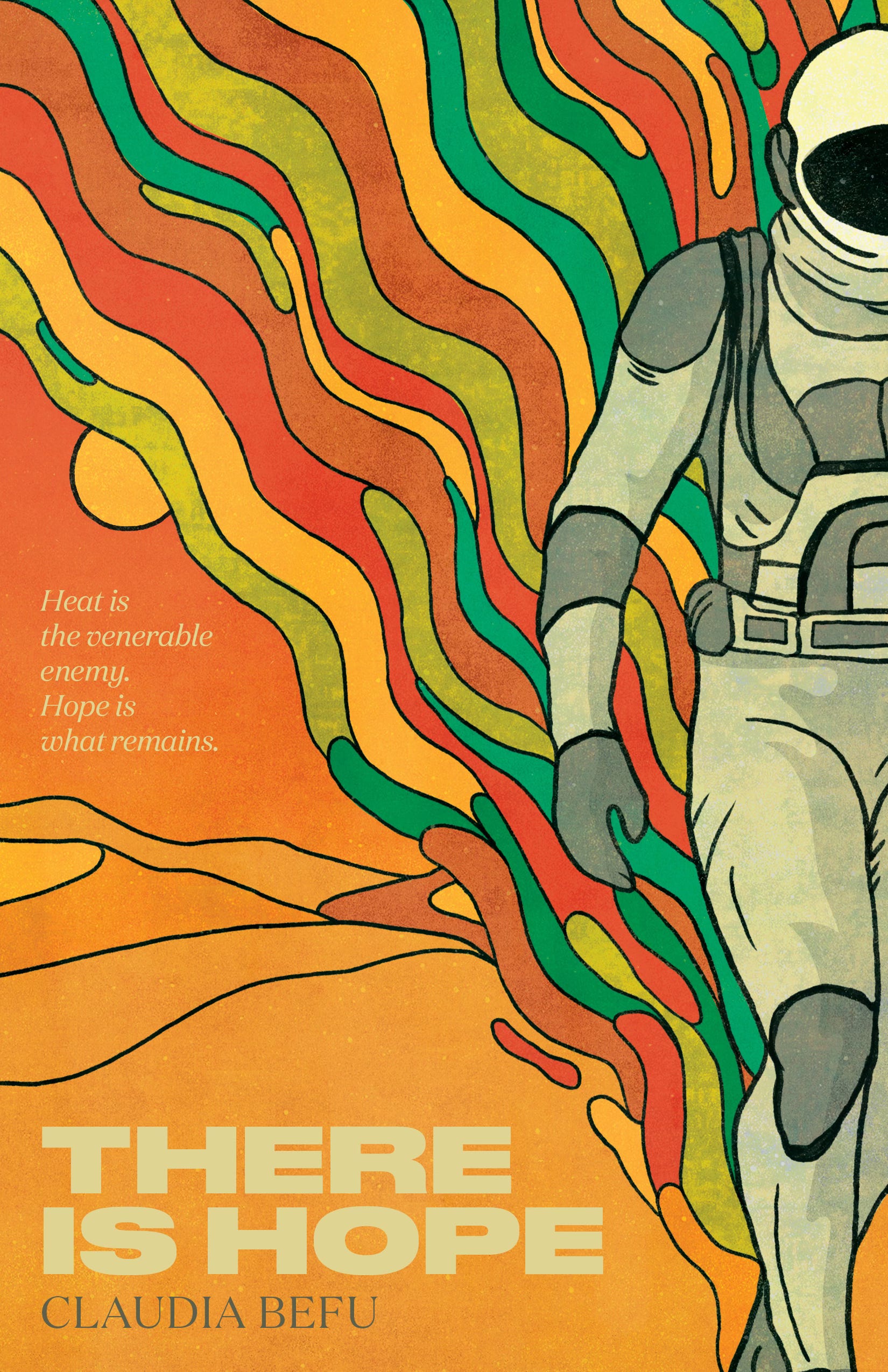
THERE IS HOPE is a climate fiction novel that explores Europe in the year 2550, four and a half centuries after we have reached 5°C of global warming.
Nova Novikov arrives on the Iberian coast to witness an annual human sacrifice and bring her daughter’s ashes to the ancient wooden shrine. But when a young girl is chosen for the ritual, Nova makes a decision that will ripple across centuries—witnessed through the preserved memories of those who shaped what comes next.
Told as a mosaic of curated stories in the year 3660, THERE IS HOPE is a climate sci-fi novel about ecological reckoning, sacrifice, and the fragile persistence of hope at the end of the world.
In every carbon cycle, death is the engine of life.
Heat, the venerable enemy, will kill us first
We, humans, are capable of change at scale as we proved time and again throughout our 300,000 years of living on this planet. However, that same history tells us that great change comes only after great pain.
At the end of the last Ice Age, episodes of abrupt climate change melted the ice world of our ancestors flooding the tundra landscape and killing the mammoths, raising sea levels and separating continents, and upending a culture and a lifestyle that had lasted for 40,000 years. If they wanted to survive, humans had no choice but to transit to a whole new way of existing on this planet. Thus, at the beginning of the Holocene, the current interglacial period, they started the Agricultural Revolution. About 12,000 years later, another climate change event, the Little Ice Age that lasted 500 years—and, at its peak, saw European temperatures drop by as much as 2°C—pushed hunger stricken Europeans to upend our agrarian society and start an Industrial Revolution.
Today, we live in a materialistic society that believes it has mastered “nature” and can extract unlimited human and technological progress from this planet if only we could consume more energy. Meanwhile, we have a window of seventy-five years to stop global warming and ensure the survival of our species. In my novel, heat is the venerable enemy because it will destroy our false sense of control over planetary systems that operate on time scales so vast, that we cannot even begin to comprehend. As the equator becomes uninhabitable, fertile lands turn into deserts and dust bowls, as the oceans start dying and we face increased freshwater shortages, and heatwaves, wildfires, floods, hurricanes, and tornadoes devastate our ecosystems, we will learn to once again respect life on this planet as the greatest good we have. The author of The Uninhabitable Earth: Life After Warming, David Wallace-Wells, writes:
“There is no good thing in the world that will be made more abundant, or spread more widely, by global warming.”
When the heat strikes and we turn on the air conditioner in the shelter of our first world homes, trees scream in pain from thirst as they crack open, birds fall dead from the burning sky, and fish boil alive in rivers and oceans. We can hide from the heat for now, but we won’t be able to hide for long.
Who owns the food, owns the future
Over thousands of years, indigenous tribes living in the equator and the tropics grew the diversity of food crops we enjoy around the world. However, today’s human society allows a handful of agrochemical conglomerates to steal and patent our seeds, turning 12,000 years of collective food inheritance into private property. These conglomerates promote unsustainable farming practices that poison our soils, push farmers to use patented crack-seeds addicted to their agrochemicals, while farmers are barred from saving those seeds, under threats of lawsuits. The greed of these conglomerates moved our agricultural practices from diverse and resilient crops to monocultures of a handful of types of seeds vulnerable to pests, fungi, and heat.
So far, these companies have relied on their financial power and public ignorance to sell us a story that the engineered seeds and the potent pesticides are needed to produce enough food for our growing world population. But studies show that crops from seeds engineered to resist pests and weeds with the help of agrochemicals, do not yield more production than historical cultivars—locally grown seeds—that are better equipped to resist familiar and unfamiliar threats than modern cultivars. Today, whenever we lose a type of seed, we can go back to its place of origin in the equator or the tropics and find an ancestor that can help us retrieve it because nature is much better at engineering seeds. But as these regions become uninhabitable, due to global warming, both for humans and the plants that feed us, we will increasingly rely on seed banks to ensure our food diversity. What is the future of our food? In his book Seeds of Resistance: The Fight to Save our Food Supply author Mark Shapiro writes:
“The seed oligopoly we see today was built upon the conversion of freely grown and exchanged seeds into seeds as intellectual property.”
And those who own the intellectual property over our food, own our future.
The boreal forest could be our last forest
During our time on this planet, our species survived through at least two Ice Age cycles that lasted 100,000 years each. At the end of the last Ice Age, humans helped re-green the earth by planting trees from preserved seeds in the northern hemisphere. Some of those same forests were later on cut to feed the needs of the Roman Empire and of a civilization built on timber.
What survives today of the boreal forest or the taiga grows just south of the Arctic Circle and is the world’s largest biome representing a third of Earth’s forested area. The special thing about the taiga is its resilience: this forested area has been decimated by each ice age cycle but it bounced back to life every time propitious climate conditions arrived. The taiga is the youngest large forest biome on Earth but its location and its history of climate survival may ensure its endurance in hotter times, while older forests such as the Daintree Rainforest in Australia or the Amazon that lived uninterrupted through every Ice Age cycle for the past 2.6 million years may not survive a world on fire.
If the world heats up 5°C by the end of this century, Canada, Alaska, Scandinavia, and Russia will be the only regions with access to the boreal forest, fertile soils, fresh water, and cool weather conditions friendly to life. Where will everyone else go? In the frenzy of our lives, we don’t allow ourselves time to think about the ecosystems that give us food, oxygen, water, and life even as they break before our eyes. As Ben Rawlence writes in The Treeline: The Last Forest and the Future of Life on Earth:
“The unnatural has become natural, the apocalyptic has become prosaic, a perennial event merging into the background. This, perhaps, is one of the emerging realities of climate breakdown: that grief is a luxury. The urgent demands of daily life allow for no such respite or detachment.”
For now, we still have the luxury to ignore the destruction of the natural world and cruise through life in our consumerist society high on techno-utopian dreams. But we live on borrowed time and those dreams are shattered with every new molecule of carbon dioxide we add into the air in our rush to burn our way to a living hell. And one day, we’ll be down to the last forest, the last sharks, the last food crops, and the last humans.
I also talked with Vince Wetzel about the world of “There Is Hope” and how I came to write it.

There Is Hope: Amazon US | Amazon UK | Amazon AU | Amazon CA | Amazon DE | Amazon ES